
Growing your revenue is exciting. But are you building a business that can actually sustain that growth?
Recently, my husband David, who is also our CFO, our Operations Manager Melissa, and I sat down to review the financial health of Integrity Bookkeeping Pros (IBP) and plan our growth for the next quarter.
We weren’t just looking at how much money we made or how much we spent.
We wanted to understand where we are today, how efficiently we’re operating, how many additional clients our current team can support, and how we can continue adding value to the clients we already serve.
And you know what we discovered?
We have the capacity to grow our revenue by 25% without hiring another employee.
Think about that for a moment.
We don’t need to immediately increase payroll, add more office space, or take on additional overhead to reach our next revenue goal.
What we need is a clear strategy, the right clients, and a team that’s prepared to serve them well.
But here’s the important part: We wouldn’t have been able to make those decisions confidently without understanding our numbers.
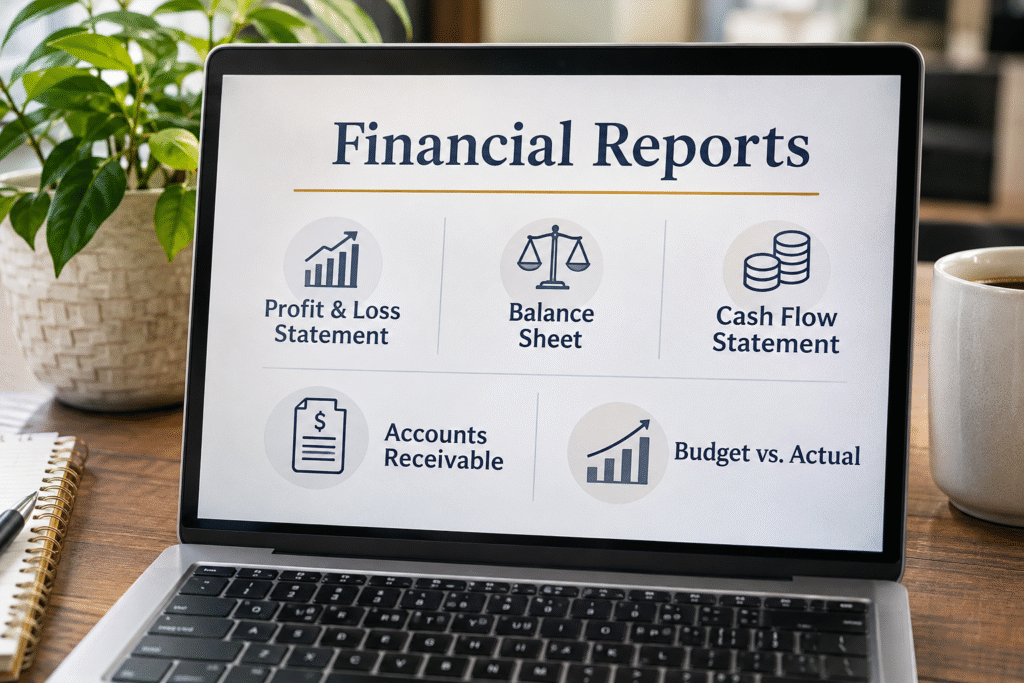
And that’s what I want to talk to you about today. Below are the five financial reports every business owner should review, and the questions to ask about each one.
Growth Doesn’t Always Mean Hiring More People
One thing I’ve learned as a business owner is that increasing revenue and building a financially stronger company aren’t necessarily the same thing.
I see this especially with businesses generating $500,000 or more annually.
At this stage, you’re often wearing multiple hats, your team is getting busier, and you’re starting to wonder whether it’s time to bring on another employee.
And sometimes it absolutely is.
But before making that decision, I want you to ask yourself a few questions.
- Do you actually need another employee, or do you need better systems and processes?
- Is your current team operating at capacity, or are there opportunities to improve efficiency?
- Will the additional revenue support the full cost of another employee, including payroll taxes, benefits, training, and equipment?
- Will that hire strengthen your business financially or put additional pressure on your cash flow?
Because here’s the reality:
You can grow your revenue and still weaken your business financially.
A $55,000 employee doesn’t necessarily cost your business just $55,000. Once you account for employer payroll taxes, benefits, software, equipment, and training, the actual investment can be considerably higher.
If your profit margins and cash flow can’t support that investment, you may find yourself working harder just to maintain the business you’ve already built.
That’s why our meeting at IBP was so valuable.
We weren’t asking how many people we needed to hire to grow. We were asking how much growth our existing team could responsibly support while continuing to deliver excellent service.
And the numbers gave us an answer.
We identified the capacity to increase revenue by 25% without adding additional staff.
That doesn’t mean we’ll never hire again. It means we can make our next hiring decision intentionally, rather than reacting to how busy we feel.
That’s the difference between growing a business and building a sustainable one.
Your Financial Reports Should Do More Than Tell You What Happened Last Month
I talk with business owners all the time who work incredibly hard.
They’re bringing in revenue, managing employees, taking care of customers, and trying to build something successful.
But when I ask how their business is actually performing financially, many aren’t quite sure.
They know what their bank balance is. They know whether sales are up or down. They might even know roughly what their monthly expenses are.
But that’s not the whole picture.
Your bank balance doesn’t tell you how profitable your business is. And your revenue doesn’t tell you how much money you get to keep.
If you’re serious about growing your business profitably, I believe there are five financial reports you should review every month.
And at the very minimum, you should be sitting down for a thorough financial review every quarter.
You don’t need an accounting degree to understand them. You just need to know what they’re telling you and what questions to ask.
1. Profit and Loss Statement: Are You Actually Making Money?
Your Profit and Loss Statement (P&L), sometimes called an Income Statement, shows how much revenue your business earned, what it cost to operate, and what’s left over.
This is one of the first reports I want business owners to understand.
Let’s say your business generates $100,000 in monthly revenue.
That sounds great, right?
But what if it costs you $95,000 to generate that revenue?
You’re only left with $5,000 in profit.
Now imagine another business generating $75,000 per month but keeping $20,000 in profit.
Which business would you rather own?
Revenue is exciting, but profitability is what helps create a sustainable business.
When reviewing your P&L, ask yourself whether your revenue is growing and whether your expenses are increasing faster than your revenue. Look at which expenses are necessary and which aren’t producing value, and figure out what percentage of revenue you’re actually keeping as profit. And ask whether your services or products are priced appropriately.
The goal isn’t always to sell more. Sometimes it’s to become more profitable with what you already have.
2. Balance Sheet: What Does My Business Actually Own and Owe?
I’ll admit, the Balance Sheet isn’t usually the report business owners get excited about.
But it’s incredibly important.
Your Balance Sheet gives you a snapshot of your company’s financial position at a specific point in time.
It shows three things:
Assets: What your business owns or is owed, such as cash, equipment, and outstanding customer invoices.
Liabilities: What your business owes, including loans, credit cards, and unpaid bills.
Equity: The difference between your assets and liabilities.
Here’s why this matters.
A business can show a profit on its P&L and still be carrying significant debt, struggling with collections, or operating with very little available cash.
Your Balance Sheet helps you see those issues.
I encourage business owners to ask:
- How much debt is my business carrying?
- Do I have enough current assets to cover upcoming obligations?
- Are my outstanding customer balances increasing?
- Is my business becoming financially stronger over time?
If you’re planning to expand, hire employees, purchase equipment, or take on financing, you need to understand your Balance Sheet.
Growth is exciting, but you want to make sure you’re building on a financially healthy foundation.
3. Cash Flow Statement: Where Is All My Money Going?
Have you ever looked at your P&L, seen a profit, and wondered why there isn’t more money in the bank?
You’re certainly not alone.
This is one of the most common frustrations I hear from business owners.
Your Cash Flow Statement helps explain where cash came from and where it went.
It breaks cash movement into three categories:
- Operating activities: Cash coming in and going out through your normal business operations.
- Investing activities: Cash spent on or received from things like equipment and other long-term assets.
- Financing activities: Cash related to borrowing, loan repayments, and owner contributions or distributions.
Here’s a simple example.
Your business might generate $20,000 in profit, but if customers haven’t paid their invoices, you’re paying down loans, or you’ve made a large equipment purchase, your available cash could be much lower.
Profit and cash flow are not the same thing.
At IBP, David is taking a more active role in our financial reporting, including reviewing cash flow weekly.
Why weekly?
Because I don’t want to find out at the end of the month that we have a cash flow problem we could have anticipated three weeks earlier.
I want to make decisions before there’s a problem, not after.
And that’s what understanding cash flow allows you to do.
4. Accounts Receivable: Who Owes You Money?
If your business invoices customers and allows them to pay later, your Accounts Receivable (A/R) Aging Report should be part of your regular financial review.
This report shows who owes you money and how long those invoices have been outstanding.
You might have $50,000 in outstanding invoices, but how much of that money is actually coming in soon?
Are invoices sitting unpaid for 30, 60, or even 90 days?
Here’s something I want business owners to understand:
A sale doesn’t pay your bills. Collecting the money does.
If your customers are consistently paying late, you’re essentially financing their operations with your company’s cash.
And that can create a real strain on your business.
When you review your A/R, look at how much money is currently outstanding and which customers are consistently paying late. Are you following up on overdue invoices, and do you need to change your payment terms or collection process?
Sometimes improving cash flow doesn’t require generating more sales.
It requires collecting the money you’ve already earned.
5. Budget vs. Actual: Are You Following the Plan?
This is where financial reporting really starts becoming a tool for growth.
A budget isn’t just about restricting spending.
It’s about deciding where you want your business to go and creating a financial plan to get there.
Your Budget vs. Actual Report compares what you planned to earn and spend against what actually happened.
Let’s say you budgeted $15,000 for payroll, but your actual payroll expenses were $19,000.
Why?
Did you hire someone? Did overtime increase? Was there an unexpected expense?
Maybe the additional payroll was necessary because your revenue grew significantly.
Or maybe your labor costs are increasing without a corresponding increase in productivity or revenue.
You need to understand the difference.
The same goes for revenue.
If you planned to generate $80,000 and only generated $65,000, you need to understand why.
Was it a sales issue? A pricing issue? A seasonal change?
Your budget gives you a target. Your actual results tell you how you’re performing against it.
Without a plan, you’re simply reacting to whatever happens next.
And that’s not how I want to run a business.
Why Quarterly Financial Reviews Are Essential for Profitable Growth
Here’s something I want every business owner to consider.
If you’re generating $500,000, $1 million, or $2 million in annual revenue, when was the last time you sat down and really evaluated your company’s financial performance?
Not just looked at your bank account.
Not just checked whether you had enough money to make payroll.
I mean actually sat down, reviewed your financial statements, evaluated your expenses, and discussed where your business is headed.
If you want to scale profitably, a comprehensive financial review every quarter should be a minimum expectation.
Ideally, you’re reviewing your financial reports monthly, with cash flow and outstanding receivables monitored even more frequently.
But every quarter, you should be stepping back and looking at the bigger picture.
Ask yourself:
- Is our business more profitable than it was last quarter?
- Are our profit margins improving or shrinking?
- Can our current team support additional revenue?
- Are we spending money in areas that aren’t producing results?
- Do we have enough cash to support our growth plans?
- What opportunities exist to provide more value to our existing customers?
- What needs to change over the next 90 days?
And don’t stop at reviewing the reports.
Use what you learn to make decisions.
You Don’t Have to Become an Accountant. But You Do Need to Understand Your Business.
I don’t expect every business owner to know how to reconcile a bank account, prepare adjusting journal entries, or understand every accounting principle.
That’s why accountants and bookkeepers exist.
But I do believe every business owner should be able to sit down with their financial reports and understand what those numbers are telling them.
Because ultimately, you’re the one making the decisions.
You’re deciding when to hire, when to invest, when to expand, when to increase prices, and sometimes when to pull back.
Those decisions shouldn’t be based solely on how busy you feel or how much money happens to be sitting in your bank account.
They should be based on reliable financial information.
Start With One Financial Meeting
If you’re not reviewing your financial reports regularly, here’s my encouragement.
Start now.
Block off 60 minutes after your next monthly or quarterly financial close.
Sit down with your bookkeeper, accountant, CFO, or leadership team and review these five reports.
Don’t just ask, “Did we make money?”
Ask better questions.
What improved? What needs attention? Where are we losing money? What opportunities are we missing? And what decisions do we need to make for the next 90 days?
You might be surprised by what you discover.
We certainly were.
Ready to Make Your Numbers Work for You?
At Integrity Bookkeeping Pros, we believe bookkeeping should be about more than keeping your records organized and preparing for tax season.
Accurate bookkeeping is the foundation. Understanding what those numbers mean is where business owners begin making more confident decisions.
Whether you’re trying to improve cash flow, increase profitability, or prepare for your next stage of growth, it starts with knowing where you stand today.
Because you can’t confidently plan where you’re going if you don’t understand where you are.
If you’re ready to gain a clearer understanding of your business finances, explore our monthly accounting and reporting and controller services, or contact us to get started.
Integrity Bookkeeping Pros: Helping business owners gain clarity and confidence in their finances.